Showing posts with label logistic. Show all posts

Thursday, May 13, 2021

SPEDIZIONI AUTOMATIZZATE AI CORRIERI E ROBOT PACKAGING IN ZEISS - Automatic courier shipping and packaging automation in Zeiss

ENGLISH VERSION BELOW  


Nella sede principale della divisione Vision Care di ZEISS
è stata implementata un’interessante applicazione per la gestione automatizzata delle lenti prodotte e delle successive fasi di packaging e smistamento per l’invio al cliente. Alta efficienza con i robot Racer 7 di Comau integrati da SISCODATA presso la Carl Zeiss

Si tratta di un' applicazione finalizzata alla ottimizzazione della logistica attraverso la gestione automatizzata delle lenti prodotte e delle successive fasi di packaging e smistamento delle stesse per l’invio al cliente,con protagonista Siscodata integratore di linee automatizzate che seguono la produzione di prodotto fino all'assemblaggio, all’imballaggio e alla pallettizzazione.

On photo :Shipment automation to different courier areas

Zeiss serve quotidianamente con singole coppie di lenti costruite e preparate qui in base alle necessità visive del portatore finale degli occhiali. Ai 4.500 ottici sono inviate, per quasi 365 giorni all’anno, una media di 13.000 lenti al giorno che si traduce in 6.500 spedizioni. Si tratta di lenti che, in alcuni casi, sono già pronte a magazzino e le trasformiamo in base alla richiesta, in altri casi vengono realizzate ad hoc gli stabilimenti sulla base di una specifica prescrizione inviate a Zeiss. Le prime, generalmente, vengono consegnate all’ottico nell’arco di 24 ore, le seconde possono richiedere fino a una settimana per la consegna.

Entro sera si deve essere in grado di preparare per gli spedizioneri tutti i prodotti ordinati, pronti ad essere consegnati suddivisi per linee di spedizione e per provincie di destinazione con relativo invio dei dati ai sistemi informativi dei vettori per le consegne del giorno dopo.

Questa organizzazione logistica, è stata migliorata attraverso interventi di automatizzazione nel flusso delle operazioni, abitualmente affidate all’uomo,per conseguire livelli di efficienza maggiori.

Questo graduale avvicinamento alle tematiche di automatizzazione flessibile, ha portato a un processo di trasformazione delle attività step-by-step, affidando lo sviluppo dell’applicazione alla società Siscodata, di Arcisate anch’essa nella provincia di Varese.

Spedizioni corrieri automatizzate


Attualmente, il progetto si è concretizzato nell’implementazione successiva di due celle robotizzate. In ordine di realizzazione.

La prima cella, che utilizza un robot Racer7 della Comau, è destinata allo smistamento delle confezioni di lenti ai vari corrieri destinazione

La seconda cella, che utilizza altri due robot Racer7, provvede all’imbustamento delle lenti con relativa identificazione dei vari prodotti raggruppati in vassoi, poi trasferiti alla cella precedentemente citata tramite AGV.

Sorting shipment courier by ID laser


Siscodata e Comau: binomio vincente

La prima cella – spiega Roberto Brambilla, titolare di Siscodata - riguarda l’automazione della fase logistica di smistamento per una linea di spedizione buste formato A4 e contenenti lenti realizzate su ricetta personalizzata dal singolo ottico. Il sistema controlla l’ingresso delle cassette, in arrivo dalla cella precedente, al cui interno sono posizionate le buste da spedire le quali hanno il barcode rivolto verso l’alto. Un piano inclinato dentro la cassetta consente un miglior posizionamento delle buste all’interno della stessa. La cassetta, caricata in ingresso su un accumulo, raggiunta la fine del nastro trasportatore, viene spinta e successivamente tenuta nella zona di presa del robot dove lo scanner ID legge il codice a barre presente sulla busta. Il sistema centralizzato di gestione delle spedizioni invia al robot una stringa per specificare la baia corrispondente al corriere che ha in gestione determinate località e il robot procede di conseguenza al prelievo della busta e al suo rilascio sullo scivolo della baia corrispondente. Le buste vengono gestite una dopo l'altra in sequenza fino ad esaurimento della cassetta, esaurimento controllato tramite il catarinfrangente posto sul fondo della scatola.

La cassetta vuota – continua Brambilla - viene poi trasferita tra la macchine a CNC per la formatura delle lenti e la seconda cella Siscodata/Comau: la coppia di lenti lavorate è posizionata su un vassoio, corredato di etichetta elettronica intelligente con barcode e scritte riprogrammabili, che entra nella cella dove due Racer7 manipolano le lenti; queste vengono inserite in bustine identificabili e impilate in buste A4 su cui è scritto il nome del cliente e le caratteristiche ottiche delle lenti. Tutte le buste, riempite con istruzioni d’uso e garanzia, vengono chiuse e impilate nella cassetta che verrà inviata alla cella di smistamento, descritta prima.”

Si tratta di una serie di operazioni logistiche molto semplici che con la loro automatizzazione hanno consentito di ottenere una serie di vantaggi quali: il rispetto dei tempi di esecuzione delle attività, annullamento degli errori, riduzione dei costi del servizio e dei costi diretti e, oggi particolarmente importante, rispetto del distanziamento sociale grazie alla riduzione della presenza di personale.

Per ogni informazione chiamate +39.0332.472.471  o inviare mail a info@siscodata.com

Packaging lens in Zeiss


At the headquarters of the Vision Care division of ZEISS, an interesting application has been implemented for the automated management of the lenses produced and the subsequent packaging and sorting stages for dispatch to the customer. High efficiency with Comau's Racer 7 robots integrated by SISCODATA at Carl Zeiss

This is an application aimed at optimizing logistics through the automated management of the lenses produced and the subsequent packaging and sorting phases of the same for shipment to the customer, with Siscodata as the protagonist, integrator of automated lines that follow the production of the product up to assembly, packaging and palletizing. 


VIDEO of the 2 applications by Siscodata

Zeiss serves daily with individual pairs of lenses built and prepared here based on the visual needs of the final eyewear wearer. An average of 13,000 lenses are sent to the 4,500 opticians almost 365 days a year, which translates into 6,500 shipments. These are lenses that, in some cases, are already in stock and we process them according to request, in other cases they are made ad hoc in the factories on the basis of a specific prescription sent to Zeiss. The former are generally delivered to the optician within 24 hours, the latter can take up to a week for delivery.

Lens on tray at the picking point with special gripper


By the end of the day, all the ordered products must be ready to be delivered to the shippers, subdivided by shipping lines and destination provinces, and sent to the carriers' information systems for the next day's deliveries.

This logistic organization has been improved through interventions of automation in the flow of operations, usually entrusted to man, to achieve higher levels of efficiency.

This gradual approach to the themes of flexible automation has led to a step-by-step transformation process, entrusting the development of the application to the company Siscodata, from Arcisate, also in the province of Varese.

Currently, the project has resulted in the successive implementation of two robotized cells. In order of implementation.

The first cell, which uses a Racer7 robot from Comau, is destined for the sorting of lens packs to the various destination couriers.

The second cell, which uses another two Racer7 robots, handles the bagging of the lenses with relative identification of the various products grouped in trays, which are then transferred to the previously mentioned cell by means of AGVs.


Siscodata and Comau: a winning combination

"The first cell - explains Roberto Brambilla, partner of Siscodata - concerns the automation of the logistic phase of sorting for an A4 envelope shipping line containing lenses made to a personalized prescription by the individual optician. The system controls the entrance of the boxes, arriving from the previous cell, inside of which are positioned the envelopes to be shipped which have the barcode facing upwards. An inclined plane inside the box allows better positioning of the envelopes inside it. The box, loaded at the entrance on an accumulation, reaches the end of the conveyor belt, is pushed and then held in the robot's gripping area where the ID scanner reads the barcode on the envelope. The centralized shipment management system sends a string to the robot to specify the bay corresponding to the courier that is managing certain locations and the robot proceeds accordingly to pick up the envelope and release it on the chute of the corresponding bay. The envelopes are handled one after the other in sequence until the box is exhausted, exhaustion controlled by the reflector placed on the bottom of the box.

The empty box - continues Brambilla - is then transferred between the CNC machines for lens forming and the second Siscodata/Comau cell: the pair of processed lenses is placed on a tray, equipped with an intelligent electronic label with barcode and reprogrammable writing, which enters the cell where two Racer7 manipulate the lenses; these are inserted in identifiable envelopes and stacked in A4 envelopes on which the customer's name and the optical characteristics of the lenses are written. All the envelopes, filled with instructions for use and warranty, are closed and stacked in the box that will be sent to the sorting cell, described earlier."

These are a series of very simple logistical operations that with their automation have made it possible to obtain a series of advantages such as: respect for the execution times of the activities, cancellation of errors, reduction of service and direct costs and, today particularly important, respect for social distancing thanks to the reduction of the presence of personnel."

For more information or project call +39.0332.472471 asking of dr.Laura Cattaneo or Mr.Brambilla or send an e-mail to info@siscodata.com .


Thursday, February 28, 2019

Sistema di smistamento automatico - Courier automatic sorting system.


Andiamo a presentare un nuovo progetto realizzato riguardante l'automazione della logistica di una nota casa di ottica nella fase di smistamento per sua linea di spedizione buste.
Il sistema controlla l'ingresso delle cassette al cui interno sono posizionate le buste da spedire le quali hanno il barcode rivolto verso l'alto. Un piano inclinato dentro la cassetta consente un miglior posizionamento delle buste all'interno della stessa. Il prodotto contenuto nella busta si trova nella parte bassa del piano inclinato, mentre il numero massimo di buste all'interno della cassetta è vincolato all'altezza della cassetta.

Le cassette, posizionate sul nastro in entrata, arrivano sul lato corto della cassetta lungo la direzione del moto con la parte alta del piano inclinato verso a destra. La cassetta, raggiunta la fine del nastro trasportatore, viene spinta e successivamente tenuta nella zona di presa del robot dove lo scanner legge il codice a barre presente sulla busta.


Il sistema di gestione delle spedizioni invia al robot una stringa per specificare la baia dove posizionare la busta ed il robot procede di conseguenza al prelievo della busta e al suo rilascio sullo scivolo della baia corrispondente. Le buste vengono gestite una dopo l'altra in sequenza fino ad esaurimento della cassetta, esaurimento controllato tramite il catarinfrangente posto sul fondo della scatola.
La scatola vuota viene poi rilasciata dal pistone e portata all'esterno dell'impianto dall'apposito nastro trasportatore.


Per ulteriori informazioni contattate il nostro ufficio nella persona del Sig. Brambilla o della Dott.ssa Cattaneo utilizzando il nostro indirizzo mail info@siscodata.com o il numero di telefono +39.0332.472471. 

We are going to present a new project realized regarding the logistic automation of a well-known optical company during the sorting phase of its shipping to up to 48 different courier locations. Everyday more of 3000 packs are delivered. 
The system controls the crates entry of the crates inside which the packs are positioned with the barcode facing upwards (Barcode visible), ready to be shipped. An inclined plane inside the crate allows a better positioning of the packs inside, making gravity work in favor. The product contained in the pack is laying at the bottom, while the maximum possible number of packs allowed inside the crate is tied to the height of the pack/bag (generally 10-15 pcs).

The crates, positioned on the incoming transport, arrive on the short side of the crate along the direction of the motion. When the end of the transport is reached, the crate is pushed and then held in the robot gripping area where the scanner reads the barcode on the customer's packs/bags and through the database decides the courier.


In fact, the shipment management mainframe sends to the robot a string specifying the bay/courier where to place the pack and the robot then proceeds to pick up the pack by vacuum and release it on the corresponding bay slide. The packs are managed one after the other in sequence until the crate is empty, the system controls the emptiness of the crate thanks to a reflector placed on the internal of the crate.
The empty crate is then released and brought outside the plant by the transport up to an AGV (Automated Vehicle) while a new crate full takes place.

For more info ask Mr. Brambilla or Mrs. Laura Cattaneo at +39.0332.472471 or send a mail at info@siscodata.com.

Thursday, July 19, 2018

Order picking by robot + vision and AGV shuttle with new multi purpose gripper / Prelievo ordini automatizzato

L’Order Picking diventa flessibile
Investire nell’innovazione tecnologica significa comprendere le esigenze dei clienti e progettare soluzioni su misura.SISCODATA e  Comau lavorano per realizzare impianti robotizzati, flessibili e completi,caratterizzati da un’automazione a 360 gradi, in grado di rendere più efficiente il processo produttivo del cliente nella general industry .....con un occhio particolare al FOOD ed alla GDO.

 
A lato cella demo per l’Order Picking di prodotti alimentari confezionatie progettata dall’integratore
Siscodata computer di Arcisate (va) realizzata con il robot antropomorfo Comau Racer-7-1.4. 

  Comau S.p.A., azienda torinese leader mondiale nella fornitura di prodotti e soluzioni per l’automazione,lavora con i propri integratori per realizzare impianti robotizzati, flessibili e completi, caratterizzati da un’automazione a 360 gradi, in grado di rendere ancora più funzionale ed efficiente il processo produttivo del cliente finale.
Uno degli ultimi prodotti di questo positivo connubio tra costruttore e integratore di sistemi è la nuova cella compatta per l’Order Picking di prodotti alimentari confezionati.


La cella demo, progettata dall’integratore Siscodata Computer diArcisate (VA), azienda specializzata in sistemi di movimentazione automatizzati nel settore del Food & Beverage, prevede un robot antropomorfo Comau della famiglia Racer,il Racer-7-1.4. Prestazioni, design,
interfaccia utente, software: queste sono le caratteristiche alla base del robot Racer-7-1.4, il più veloce della sua categoria. Con portata di 7 kg e sbraccio di 1.400 mm, il Racer-7-1.4
di Comau garantisce prestazioni e precisione in una meccanica compatta, dal design evoluto e ricercato,dalle forme studiate nei minimi dettagli: eleganza e potenza in un blocco di tecnologia e passione italiana.


Questo modello racchiude in sé tutte le caratteristiche necessarie per prestazioni all’altezza delle richieste cella demo per l’Order Picking di prodotti alimentari confezionati e progettata
dall’integratore Siscodata computer di Arcisate (Va).
 La base è realizzata con un design innovativo e slanciato che assicura la massima stabilità del robot. E-motion, la nuova release del software per i robot Comau, è l'intelligenza  in grado di ottimizzare e rendere più fluidi i movimenti. Velocità e precisione, ma non a discapito della robustezza e dei consumi: Racer-7-1.4 infatti è qualficato con classe IP65 che permette una protezione dagli ambienti piùostili e garantisce consumi ridotti grazie alla minor potenza installata.


Il robot è programmabile per essere in grado dimovimentare e inscatolare prodotti molto diversi tra loro come scatolette, barattoli, confezioni doypack,utilizzando pinze diverse a secondadella tipologia di prodotto da prelevare.


La pinza multifunzione presenta da uno a tre diversi sistemi di presa,selezionabili tramite il programma dal robot, e ognuno di questi sfrutta principi fisici diversi e specifici per prelevare prodotti di differente natura, forma e materiale. Inoltre, il
prelievo di prodotti fragili e delicati avviene nel rispetto sia delle superfici dell’imballo sia del contenuto.


Tale pinza multifunzione, ingegnerizzata da Siscodata Computer,
sfrutta principi fisici diversi tra loro:in specifici casi viene utilizzata unapinza con dita di gomma siliconica
molto flessibili, in altri una pinza a “levitazione” o da ultimo un sistema con ventose. 

Il robot può essere opportunamente programmato per effettuare dei cambi pinza automatici, prelevando le differenti pinze da un magazzino di stoccaggio adiacente.


The Order Picking becomes flexibleInvesting in technological innovation means understanding the needs of customers and designing tailor-made solutions.SISCODATA and Comau work to create robotised, flexible and complete systems, characterized by 360-degree automation, able to make the customer's production process more efficient. in the general industry ..... with a particular eye to the FOOD and the GDO.A demo cell for the Order Picking of packaged food products designed by the integrator Siscodata computer of Arcisate (VA) made with the anthropomorphic robot Comau Racer-7-1.4.
Comau SpA, a Turin-based company of FCA Group (FIAT Chrisler car  Group) worldwide leader in the supply of products and solutions for automation, works with its own integrators to create robotised, flexible and complete systems, characterized by 360-degree automation, able to make it even more functional and efficient the production process of the final customer.One of the latest products of this positive combination between manufacturer and system integrator is the new compact cell for Order Picking of packaged food products.The demo cell, designed by the integrator Siscodata Computer diArcisate (VA), a company specialized in automated handling systems in the Food & Beverage sector, provides a Comau anthropomorphic robot of the Racer family, Racer-7-1.4. Performance, design,user interface, software: these are the basic features of the Racer-7-1.4 robot, the fastest in its class. With a capacity of 7 kg and a 1,400 mm outreach, the Racer-7-1.4of Comau guarantees performance and precision in a compact mechanism, with an advanced and refined design, with shapes studied in every detail: elegance and power in a block of Italian technology and passion.


This model contains all the features necessary for performance up to the demands of the demo cell for the Order Picking of packaged and designed food productsfrom the Siscodata computer integrator of Arcisate (Va).
 
The base is made with an innovative and slender design that ensures maximum stability of the robot. E-motion, the new software release for Comau robots, is the intelligence that can optimize and make movements smoother. Speed ​​and precision, but not to the detriment of strength and consumption: Racer-7-1.4 is in fact qualified with IP65 class that allows protection from more-or-less environments and ensures reduced consumption thanks to lower installed power.
The robot is programmable in order to be able to degrade and box products that are very different from one another as cans, jars, doypack packs, using different pliers according to the type of product to be taken.


The multifunction gripper presents from one to three different gripping systems, selectable through the program by the robot, and each of these exploits different physical principles and specific to take products of different nature, shape and material. Furthermore, thepicking up fragile and delicate products takes place respecting both the packaging surfaces and the contents.This multifunctional gripper, engineered by Siscodata Computer, exploits different physical principles: in specific cases, a silicone rubber finger is used.very flexible, in others a "levitating" forceps or, lastly, a system with suction cups.


The robot can be appropriately programmed to perform automatic gripper changes, taking the different grippers from an adjacent storage warehouse.
  
For more info ask Mr.Brambilla or Mrs.Laura Cattaneo at +39.0332.472471 or send a mail at info@siscodata.com

Sunday, March 6, 2016

EVENTO NUMBER 1 LOGISTICS GROUP / NUMBER 1 LOGISTICS GROUP EVENT

Il 2 marzo 2016 si svolto, presso la sede di Parma di Number 1 Logistics Group, il convegno "L'innovazione della logistica" nel quale la stessa Number 1 ha presentato la sua nuova linea robotizzata realizzata da Siscodata con robot antropomorfi COMAU. Questa linea è stata realizzata sulle specifiche esigenze e sui prodotti che Number 1 quotidianamente movimenta ed è 100% "made in Italy".
Sono stati ad oggi pubblicati diversi articoli, tra cui i seguenti:
Per maggiori informazioni Vi preghiamo di contattare i nostri uffici nella persona del Sig. Brambilla utilizzando il nostro indirizzo email info@siscodata.com o chiamando il numero +39.0332.472471.

On March 2, 2016 in Number 1 Logistics Group headquarters (of Parma), was held the conference "Logistics Innovation" in which Number 1 introduced its new robotic line realized by Siscodata with anthropomorphic COMAU robots. The entire line has been thought for the specific needed and products Number 1 daily moves and, most of all, the line is 100% "made in Italy".

Until now, has been published several articles (all in Italian language).


For more information, please contact our office in the person of Mr. Brambilla using our email address info@siscodata.com or the following phone number at +39.0332.472471. 


Friday, February 19, 2016

FORMATURA E RIEMPIMENTO DI ESPOSITORI BOX PALLET E VASSOI / DISPLAY - BOX PALLET AND TRAY DISPLAY FORMING AND FILLING PLANT _ Part 2

The plant is formed by a system performing the erecting and filling of box pallet displays and trays for the large-scale detail distribution. We can divide the plant into 3 areas:
  • box pallet display forming area and display / tray erecting area;
  • pick & place and filling area;
  • stacking area.
These last two areas can be integrated into one only.

Box pallet displays forming area:
The box pallet display forming system erects the pallet-like carton display automatically by closing the bottom part with hot melt and folding the central part. Subsequently, the display is glued on the wooden pallet or, as an alternative, is kept steady by inserting a cardboard piece inside. To automatise and accelerate these operations, it could be necessary to partially review the packaging. This system, together with the tray erecting area, forms the initial part of the whole plant automatic line.
The box pallet displays can have various dimensions and can be of 2 types (see Pict. 1 and Pict. 2):
  • TYPE 1: “classic” box pallet with bottom part closure by hot melt;
  • TYPE 2: box pallet with cardboard piece insertion after forming.
The box pallet forming system is interfaced with the display pick & place and filling part.
Fig. 5: Espositori box pallet su 1/4 di Europallet. -
Pict. 5: Box pallet displays on 1/4 Europallet.
There will be one silos with minimum capacity of 50 cartons, with easy adjustment so to handle both types and one silos for the mini-pallets (600 x 400 mm, equivalent to 1/4 of a Europallet). This silos can contain quite a few piles of 20 pcs. each.
The box pallet display forming system can form, in average, 20 box pallets/hour. 

Trays / displays forming area:
The tray / display forming area erects the carton tray automatically. Trays / displays can be of different types and sizes.
Fig. 6: Cartone piano fustellato. -
Pict. 6: Flat carton.
During tray erection, the lateral flaps are left open so to allow the product insertion during pick & place phase. After filling, in a following glueing station, the lateral flaps will be closed. There is a silos containing a few hundreds flat cartons with easy adjustment. The system forms in average 120-150 trays/hour.

The box pallet and tray displays types can be made with:
  • single-wave or double-wave carton;
  • printed single-wave or double-wave carton.
Pick & place area:
The pick & place area automatically places the products into the box pallets or trays displays. The pick & place robotic system, located after the box pallet and trays displays forming area, is able to handle different types of products, such as:
  • biscuits trays;
  • flowpacked packs;
  • glass jars in multipacks, matrix 2x1 / 3x1 / 2x2 / 3x2;
  • and so on.
The pick & place area is able to fill in:
  • box pallet from 1/4 pallet (600x400mm);
  • trays / displays from 1/4 pallet (600x400mm).
Box pallets and trays arrive to the system already formed and ready to be filled in. The automatic handling of box pallets and display trays can be adjusted easily according to the size. An operator prepares the products manually to be inserted into the box pallet / tray and loads them into the pick & place feeding unit. Subsequently, the products are picked up and placed by two anthropomorphous robots into the box pallet / tray. Depending on the type of product that has to be handled, there will be a buffer station for the automatic insertion of interlayer cardboards, or reinforcement cartons, or bee-nest product separators. Empty box pallet / trays coming from the forming area are automatically placed inside the filling area and (once pick & place and flaps closure by hot melt operations are carried out) accumulated to be subsequently stacked by the two robotic arms.
Fig. 7: Espositore da supermercato con cartoni interstrato. -
Pict. 7: Display for supermarket with interlayer cardboard.
Fig. 8: Vassoio pieno pronto per la chiusura dei lembi laterali. -
Pict. 8: Filled tray ready for lateral flaps glueing.
  
Stacking area:
The box pallet (see Pict. 4A) is already equipped with a mini-pallet or with a carton piece during the erection phase. Therefore, it is not “worked on” in the stacking area.
The trays / displays, once filled-in with the requested product, are stacked at output in the pick & place area. Then the system closes the trays upper part by glueing the lateral flaps and are placed on the wooden mini-pallet coming from the forming area (see Pict. 4B). The various operations are set on a central electrical rack for handling and control.

Fig. 9A: Vassoio su 1/4 di Europallet. -
Pict. 9A: Trays on 1/4 Europallet.
Fig. 9B: Vassoio su 1/3 di Europallet. -
Pict. 9B: Trays on 1/3 Europallet.
The plant includes 6-axis, brushless COMAU robots that perform the operations of box pallets / trays forming, pick & place and trays / displays stacking on mini-pallet.
COMAU anthropomorphous robots can reach high speed and acceleration, together with high precision and repeatability of movements. The robot, which also has an IP67 protection on the wrist, is equipped with a new C5G process computer and an ergonomical terminal with sealed membrane keyboard, colour LCD and TFT. The C5G also has an input for a USB key through which it is possible to load new pallet patterns by e-mail or take out the log, and also has the possibility to interface with the most common fieldbus as well as the possibility to exchange data by the resident Ethernet interface with the PC network already present in the plant. This way, for e.g., it is possible to transmit the log file data of the production for the packing list, or for the warehouse load.


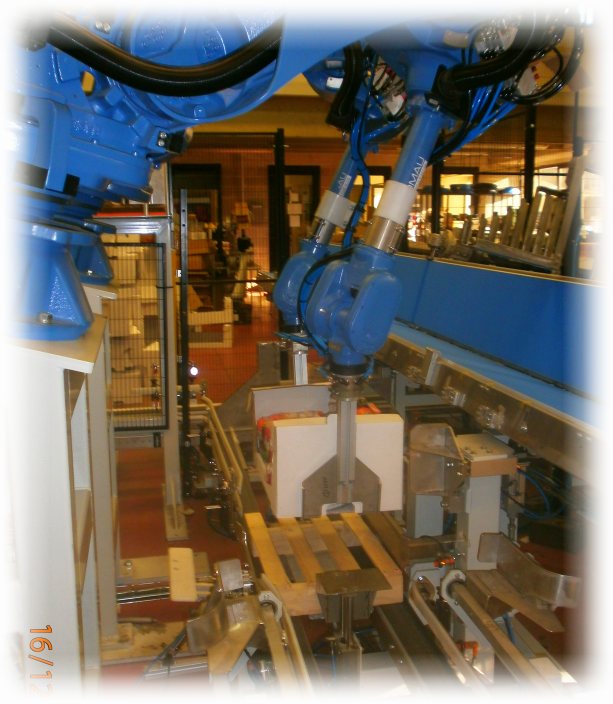
Posizionamento del vassoio per il riempimento e impilamento vassoi riempiti.
Trays positioning for filling and filled tray stacking.

For more information, please contact our office in the person of Mr. Brambilla using our email address info@siscodata.com or the following phone number at +39.0332.472471.