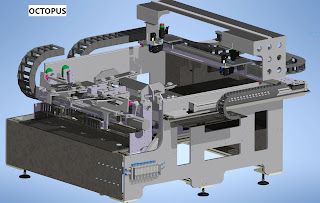
Siscodata has delivered and run a new line for forming trays with hot melt glue + creating an internal holder of the pieces into an array and insert checking the correct refill at 30 ppm.
Monday, March 16, 2026
TRAY ERECTOR ROBOTIC CARTONER FOR ARRAY OF SMALL PIECES - Formatrice vassoi e cartonatrice robot
Friday, June 7, 2024
Slowing down the GIGA-FACTORIES in Europe for European vehicle battery venture ACC - Rallentamento delle GIGA-FACTORIES in Europa per l'impresa europea ACC delle batterie per veicoli elettrici
The European vehicle battery venture Automotive Cells (ACC) said Tuesday that it was halting construction of two factories in Germany and Italy as it weighs shifting to a less-expensive battery technology.
The new ACC sites are among dozens of battery projects emerging in Europe as it seeks to reduce reliance on Chinese producers that dominate the market.
EV market demand has shifted toward so-called LFP (lithium iron phosphate) batteries, which are less powerful but also less expensive and longer lasting than NMC batteries, and increasingly found on cars made by industry leaders Tesla and China's BYD. "The European automotive industry is facing a slower growth in demand for electric vehicles and simultaneously, increasing competitive pressure," leading the company to review its "development roadmap", ACC said in a statement.
As a result, it has stopped work on the factories in Kaiserslautern, Germany, and Termoli, Italy, to evaluate the viability of developing LFP technologies at the sites.
Kaiserslautern Factory rendering
ACC will be opening its 3rd Gigafactory in Termoli, on the south Adriatic coast of Italy, in the province of Campobasso.
Mercedes’s entry as a shareholder to ACC comes with significant ambitions in terms of electric vehicle development, which has prompted us to increase the production capacity of our manufacturing lines to meet the needs of our customers.
They will increase the nominal production capacity per block of the Giga- factory planned at Billy-Berclau/Douvrin to 13.4 GWh per block by optimizing the use of the available surface initially planned for the plant.
"ACC is adapting its battery supply strategy to add new low-cost cell chemistries to the portfolio, in response to shifts in market demand toward less expensive vehicles," its secretary general told.
He said there would be a "new phase of research over the coming months so that we'll be able to produce these more affordable products".
ACC is a partnership between French energy giant TotalEnergies, Germany's Mercedes-Benz and US-European automaker Stellantis, which produces a range of brands including Peugeot, Fiat and Chrysler.
It began producing batteries at its first "gigafactory" in Douvrin (northern France) last year, for the Peugeot midsize family car, and a second production line is set to start operating in the next months.
In February, the company said it had secu for thered 4.4 billion euros in financing to build out its capacity, for a total of 13 production lines.
Siscodata has supplied and installed through COMAU the wrapping film units for the cell bodies of the Gigafactory ACC at Douvrin France.
For more information call +39 0332 472.471 or write to info@siscodata.comMonday, May 27, 2024
MGM MOTORI NUOVO SISTEMA DI MOVIMENTAZIONE CON VEICOLI A GUIDA AUTOMATICA (AGV)
NUOVO SISTEMA DI MOVIMENTAZIONE CON VEICOLI A GUIDA AUTOMATICA (AGV)
E’ entrato in funzione nello stabilimento di Serravalle Pistoiese, nel reparto assemblaggio motori, il nuovo sistema di movimentazione basato sull’uso di carrelli a guida automatica AGV già utilizzati in azienda in altri reparti.
Gli AGV riforniscono le varie stazioni di assemblaggio dei componenti necessari, provvedono alla movimentazione dei motori alle successive stazioni di collaudo e finitura fino alla fase conclusiva dell’imballaggio.
Mediante questo nuovo sistema è aumentata l’efficienza della produzione con un generale
[🇬🇧] NEW HANDLING SYSTEM WITH AUTOMATIC GUIDED VEHICLES (AGV)
The new handling system based on the use of AGV (Automatic Guided Vehicle), already used in the company in other departments, has entered into operation in the Serravalle Pistoiese plant in the brake motors assembly department.
The AGV supply the various assembly stations with the necessary components, handle the movement of the motors to the subsequent testing and finishing stations up to the final packaging phase.
Through this new system, the production efficiency has increased with a general improvement of the working environment. Siscodata's OCTOPUS-based packaging system provides for the formation of a special FEFCO carton
Friday, February 16, 2024
Lithium Cell body Plasma cleaning -E-mobility . Pulizia al PLASMA di corpi celle Litio per migliorare l'aderenza film wrap
Un ulteriore modulo robotizzato è stato introdotto da SISCODATA nella sua linea per l' E-mobility da porre dinanzi ai moduli di wrapping con film adesivo gia' illustrati nei precedenti Post. Mentre i trattamenti di pulizia con " Effetto corona " ,usati ad esempio nel campo della cartotecnica , producono emissioni di ozono i sistemi al Plasma atmosferico non ne producono.L’ozono è una molecola inquinante che non si dissolve nell’aria. Va pertanto realizzato un abbattitore catalitico multistadioa temperatura ambiente che contiene le emissioni al di sotto delle soglie fissate dalla legge,al contrario il Plasma ,non creando ozono ,non inquina.
Trattamento al plasma atmosferico
Il plasma è il cosiddetto quarto stato della materia. Quasi ogni sostanza a basse temperature solidifica, ed applicando una certa energia tramite riscaldamento passa poi allo stato liquido. Se si fornisce ulteriore energia la sostanza passa allo stato gassoso. Nel caso dei Gas ,fornendo energia al gas le molecole si separano in atomi e elettroni e si raggiunge lo stato di plasma.
Il Plasma atmosferico si ottiene creando un campo elettrico in aria e direzionando la scarica sul substrato da trattare. È solitamente ottenuto in aria, ma è anche possibile l’utilizzo di gas specifici. Il trattamento al plasma atmosferico è puntuale e pertanto meglio si adatta per il trattamento di piccole superfici, ma sopratutto, il trattamento plasma non produce ozono!La scarica plasma è ottenuta infatti da una torcia che viene posizionata sulla linea di produzione in posizione fissa o mobile .
I materiali da trattare scorrono davanti alla torcia e vengono trattati.
La scarica plasma essendo puntuale, raggiunge elevati livelli di energia e permette di raggiungere livelli di tensione superficiali molto elevati, soprattutto sui materiali plastici.
Tra le applicazioni ricordiamo il trattamento per migliorare l’ancoraggio degli inchiostri usati per la stampa o la codificazione e sulle scatole pieghevoli prima dell’incollaggio, su parti metalliche per una pulizia profonda, trattamento per favorire l’incollaggio di guarnizioni.
E’ possibile anche trattare superfici di maggiori dimensioni con la scansione della superficie da trattare montando la torcia plasma su un braccio robotico e utilizzare più torce plasma in modo da aumentare la superficie oggetto di trattamento eventualmente facendo ruotare la torcia con un motore e con la combinazione dei movimenti creare una torcia rotante che pulisce l'intera superficie trattata.
Attivazione superficiale
Una scarica elettrica in uno spazio limitato e lineare, tra un elettrodo e un contro-elettrodo isolato e collegato a massa (ionizzazione per urto)
Una scarica in aria: in questo caso il plasma diretto sul substrato rimuove le particelle contaminanti e incrementa l’energia superficiale
Velocità linea di produzione fino a 60 m/min
I principali obiettivi del trattamento sono migliorare la predisposizione all'incollaggio o alla stampa, scongiurare il distacco del rivestimento, delle vernici, delle colle ,oltre a garantire la massima aderenza, pulizia profonda e migliorare la tenuta delle colle, adesivi, inchiostri, idrorepellenza…
L'installazione in linee per produzioni in continuo, produzioni in bobina,in linea per produzioni in continuo, montaggio su bracci robotizzati per produzioni pezzo a pezzo.
I sistemi Plasma, unitamente allo sviluppo di reagenti chimici,possono migliorare ulteriormente particolari proprietà dei materiali (bagnabilità, proprietà idrofile e idrofobiche, nano-coating, resistenza, anti-fog, anti-batterici, ecc).Questi sistemi, denominati trattamenti plasma in atmosfera, si adattano anche a lavorazioni in continuo.
Per maggiori informazioni e quotazioni chiamare +39.0332.472471 o inviare mail a inf@siscodata.com
A further robotic module has been introduced by SISCODATA in its E-mobility line to be placed in front of the adhesive film wrapping modules already illustrated in previous posts. While 'corona effect' cleaning treatments, used for example in the paper industry, produce ozone emissions, atmospheric plasma systems do not. Ozone is a polluting molecule that does not dissolve in air. A multi-stage catalytic abatement system at room temperature must therefore be constructed, which keeps emissions below the thresholds set by law, whereas Plasma, which does not create ozone, does not pollute.
Plasma is the so-called fourth state of matter. Almost every substance solidifies at low temperatures, and by applying a certain amount of energy through heating it then changes to a liquid state. If further energy is supplied, the substance changes to a gaseous state. In the case of gases, by supplying energy to the gas, the molecules separate into atoms and electrons and the plasma state is reached.
Atmospheric plasma is obtained by creating an electric field in air and directing the discharge onto the substrate to be treated. It is usually obtained in air, but the use of specific gases is also possible. Atmospheric Plasma treatment is punctual and therefore best suited for the treatment of small surfaces, but most importantly, Plasma treatment does not produce ozone!
The plasma discharge is in fact obtained by a torch that is placed on the uction line in a fixed or mobile position.
The product materials to be treated flow in front of the torch and are treated.
Plasma discharge, being punctual, reaches high energy levels and allows very high surface tension levels to be reached, especially on plastic materials.
Applications include treatment to improve the anchorage of inks used for printing or coding and on folding boxes prior to gluing, on metal parts for deep cleaning, treatment to aid gluing of gaskets.
It is also possible to treat larger surfaces by scanning the surface to be treated by mounting the plasma torch on a robotic arm and use several plasma torches to increase the surface being treated, possibly by rotating the torch with a motor and with the combination of movements create a rotating torch that cleans the entire surface being treated.
Surface activation
An electrical discharge in a limited, linear space between an electrode and an isolated, grounded counter-electrode (impact ionisation)A discharge in air: in this case, the plasma directed onto the substrate removes contaminating particles and increases the surface energy
Production line speed of up to 60 m/min
The main objectives of the treatment are to improve the readiness for gluing or printing, to prevent the detachment of coatings, varnishes, glues, as well as to ensure maximum adhesion, deep cleaning and to improve the hold of glues, adhesives, inks, water repellency, etc.
Installation in lines for continuous productions, roll-to-roll productions, mounting on robotic arms for piece-to-piece productions.
Plasma systems, in conjunction with the development of chemical reagents, can further improve particular material properties (wettability, hydrophilic and hydrophobic properties, nano-coating, resistance, anti-fog, anti-bacterial, etc.).These systems, known as plasma atmospheric treatments, are also suitable for continuous processing.
For further information and quotations call +39.0332.472471 or email inf@siscodata.com
Thursday, February 15, 2024
CAR LITHIUM CELL WRAPPER VALIDIFICATION BY VISION CHECKER - Sistema di visione per il controllo della corretta applicazione di film su celle Litio per auto
Siscodata in abbinamento alla macchina wrappatrice di ultimo modello per celle al Litio di cui al precedente Post fornisce anche come opzione inseribile all'interno della macchina ad extra costo un modulo vision checker per il controllo dei difetti e la selezione dei prodotti da ricontrollare.
![]() |
| Type of defects detected by Siscodata vision system on Lithium cell wrapping |
![]() |
| Defects detected by Siscodata vision system on Lithium car cell wrapping |
Il sistema viene fornito in 2 versioni ,nella prima versione VXR 1 piu' ridotta vengono controllate solo le grandi superfici che nelle fasi successive di assemblaggio della batterie andranno a contatto con pareti di altre batterie o del carter di assemblaggio e per le quali bisogna evitare la perdita di isolamento elettrico e che bolle d'aria limitino la conducibilita' termica con la relativa dispersione di calore generato nella carica.
![]() |
| Concept idea of Vision checker for Lithium cell |
Siscodata in conjunction with the late-model Lithium cell wrapping machine mentioned in the previous Post provides alsoa vision checker module as an option that can be inserted into the machine at extra cost.The system is able to detect defects by checking and selection of products to be rechecked.
The system based on a 2048-point linear camera over an approximate cell length of 220 mm thus provides a resolution of nearly 10 pixels per millimeter.
A system of multiple multifrequency illuminators for puts to take different photos with different illumimation angles thus enhancing the defect.
The system scans the parts to be examined after they have been covered with the film and detects defects by documenting the list of defects in a searchable Log file .Defects below a certain parameterizable size are detected ,but do not affect the qualification of the part as for example too small .
The system is supplied in 2 versions ,in the first, more reduced VXR 1 version, only the large surfaces that in the later stages of battery assembly will come in contact with walls of other batteries or the assembly casing are checked and for which loss of electrical insulation and that air bubbles limit thermal conductivity with the associated loss of heat generated in charging must be avoided.
The system in the second version VXR 2, at more cost ,also examines other film-covered surfaces without thermal/electrical contact with more cameras and illuminators .
Defective cells are discharged to an alternate location from where they can then be rechecked later.
The system's high reliability and resilience ensure high throughput.
For more information call +39.0332.472471 with reference :" Lithium Cell Vision System VXR " or send email to info@siscodata.com with the same reference.
Tuesday, February 13, 2024
E-Mobility Siscodata has delivered new wrapping machine for electric car cell - Nuova macchina di avvolgimento film per celle auto al Litio
Siscodata nell'ambito della propria linea di celle robotizzate ha installato nuove macchine per avvolgimento di film su celle al Litio nel campo automotive .
Le nuove celle robotiche di dimensioni molto ridotte risultano ora completamente carterizzate assicurando ora in tal modo oltre alla sicurezza intrinseca anche una maggiore protezione dalle polveri e di conseguenza .dalle micro bolle create dai grani di sporco.Le nuove macchine oltre ad essere state migliorate per quanto riguarda la produttività,avendo ridotto il tempo ciclo del 20 % senza incidere sulla qualità dei pezzi ottenuti risultano anche molto piu' compatte rispetto al modello originale della Versione1.0 consentendo così di negli stessi spazi occupati precedentemente di avere opzionalmente anche la parte checker di controllo tramite visione ed illuminatori della venuta applicazione come controllo di qualità.
Il sistema di visione è basato su telecamere lineari da 2000 pixel con unità di controllo illuminatori multi-spettrali .Se il pezzo presenta difetti in quantità o dimensione superiori ai parametri di accettazione il pezzo viene avviato sull'uscita scarti per un successivo ricontrollo.Per maggiori informazioni scrivere a info@siscodata.com o chiamare +39.0332.472471Siscodata as part of its robotized cell line has installed new film winding machines on Lithium cells in the automotive field .
The new robotic cells of very reduced dimensions are now completely carterized ensuring now in this way in addition to intrinsic safety also greater protection from dust and consequently from micro bubbles created by grains of dirt.
The vision system is based on 2000-pixel linear cameras with multi-spectral illuminator control units .If the part has defects in quantity or size above the acceptance parameters the part is started on the scrap output for later rechecking.
For more info send a mail to info@siscodata.com or call by phone +39.0332.472471
Monday, March 13, 2023
Macchina di avvolgimento film per celle Li rettangolari - Wrapping prismatic cell lithium battery for automotive machine
Un opzione ad extra costo permette di cambiare in pochissimi minuti la bobina di film da 15 kg, mentre nel caso standard il tempo di cambio richiede da 20 a 30 minuti max.
La tolleranza accettata sulla linearità del pezzo è +/-0.1 mm su tutte e tre le dimensioni (lunghezza / larghezza / altezza) della cella.
La produttività è limitata a 6 pezzi al minuto, mentre il carico in ingresso ed in uscita è previsto tramite 2 robot di piccola taglia.
Per maggiori informazioni contattare il Sig. Roberto Brambilla o la Dr.ssa Laura Cattaneo al +39.0332.472471 o scrivere una mail a info@siscodata.com.
Siscodata, leader in the global automotive supply chain and high-value manufacturing, has chosen COMAU/ABB as a supplier of autonomous mobile robots and the COMAU/FANUC pair for collaborative robots (cobots) in order to evolve its production and internal logistics processes through automation, creating an environment where operators and machines work in harmony while achieving new goals of digitalization and sustainability.
Operating in the FOOD - GDO field (large retail and supermarket), Siscodata has now entered the automotive electrification field for the winding part of prismatic cells by transmigrating its technologies and know-how to this rapidly expanding field.
The accepted tolerance on part linearity is +/-0.1 mm on all three dimensions (length/width/height) of the cell.


.jpeg)